Friday, July 29, 2011

One Day in the "City of God" (Part 1)

Despite the fact that there were about 30 other people sleeping on the roof of the hostel, I still managed to sleep like a rock on Wednesday night.  By 7:00 am on Thursday I was well rested and we were up and on our way to breakfast.  We ate quickly and then walked to the Dome of the Rock, which was open during the morning.  This mosque was quite a sight to see.  There were many people from all over the world visiting it - Muslims and non-Muslims alike.  As I said in my last post, this mosque is the 3rd holiest site in the Islamic world.  It is the place where Muslims believe that Mohammed was taken up into heaven by the Angel Gabriel.  The Dome of the Rock has its name because it is built around a rock that Mohammed is said to have stood on when he ascended.  Another interesting fact is that the Dome was built on the site of the Second Jewish Temple.  It's important to note that the Muslims did not destroy the Temple and built the Mosque on top of it.  Rather, it was the Romans who destroyed it nearly 600 years before the Muslim armies arrived in Jerusalem.

While most of the guys that I was traveling with decided to leave from the Dome of the Rock fairly quickly and move on to another site, I decided to stay for awhile.  I sat close to the mosque for a good portion of the morning and thought a lot about how Judaism, Christianity, and Islam converge in this city, on this spot.  The Hebrews built a temple here about 3,000 years ago to worship the same God that I and millions of other people worship today.  Just about 1,000 years after it's first construction, Jesus walked in the re-constructed Temple and preached the gospel.  Then, 600 years later, Muslims believe that Mohammed ascended from the very same spot.

Of course, the importance of Jerusalem is not the only thing that these three religions share.  Christians believe in the Torah and the rest of the Old Testament written by the Hebrews. Muslims, in turn, believe in Adam, Moses, David, Jesus, and many of the stories of the Bible.  Just as the New Testament can be used to view the Old Testament in a new way, the Quran is used by Muslims to reinterpret the Bible.

All three religions share similar beliefs about the sovereignty of God, the brokenness of humankind, and the importance of love, peace, and service to the poor and disenfranchised people in society.

With so many overlapping beliefs and histories, I could not help but wonder about where the truth is located.  Does only one of these three religions contain truth?  Or, do they all manifest different truths in different ways, through different texts, and in different people.  Honestly, I couldn't even begin to answer this question - no human really can with certainty.  It is intriguing, though, to think about the ways in which these faiths converge, and to wonder what is the real truth about God.

Al-Aqsa Mosque - not to be confused with the Dome of the Rock.  This is a different mosque built very close to the Dome of the Rock.

The Dome of the Rock


The designs were incredibly intricate.


Wednesday, July 27, 2011

From Irbid To Jerusalem (Part 2)

Ok, so my last post finished with our journey through the West Bank.  Now it's time to talk about Jerusalem.  At about 1:00 pm on Wednesday we were dropped off by our bus right outside of the Damascus Gate of the Old City of Jerusalem.  Jerusalem is made up of a small "Old City," which was the original city of Jerusalem, the "New City" in West Jerusalem (controlled by Israel), and East Jerusalem (which is part of the West Bank).


The Damascus Gate
We then entered the Old City and wandered through the streets until we found our hostel.  The streets were packed with shops and people.  It was really quite a spectacle.  Here are some pictures.  Unfortunately they don't quite capture the energy of the city:


We checked into our hostel and then went up to the roof to check out the view - it was awesome!


The view from the roof

Also from the roof.  The golden dome is the Dome of the Rock, which is situated on the Temple Mount.  It is the place where Muslims believe that Mohammed ascended to heaven.  It is the 3rd holiest site (after Mecca and Medina) in the Islamic world.


Throughout our stay in Jerusalem, we slept on the roof of the Citadel Youth Hostel.  The roof, you say?!  Yes, the roof.  They actually rent out about 30 spots on the roof for very cheap rates.  Every night we had to find a mattress, a pillow, and a blanket from the pile in the shed on the roof and claim our spot amongst the throng of people who were staying there.  It was definitely less than sanitary and a little crowded, but it was worth it for the cheap price!

The roof.  Unfortunately I don't have any pictures of the roof with all the mattresses out.  I have a video, but the internet is too slow to upload it, so it will have to wait.
Having dropped off our stuff at the hostel, it was time to grab some food and see some sights.  After eating lunch, we made our way to the Temple Mount.  As we wandered through the streets, we quickly realized that something so seemingly insignificant as asking directions to the Temple Mount was a very politically-charged question.  One of my friends approached a man who he thought was Arab and greeted him with the traditional Arabic/Islamic greeting, "as-salaamu alaykum" (peace to you).  Unfortunately for my friend, this guy was most definitely Jewish and did not appreciate being greeted in Arabic.  So, when my friend asked for directions, he was rebuffed quite quickly.  Similarly, I asked a Palestinian where the "Temple Mount" was and he told me that the Temple Mount did not exist.  I quickly realized my error and asked him where the Dome of the Rock was, and then he responded with directions.  He made sure to tell me, though: "Don't ask for what is not there anymore."


Now, I don't mean to make it sound like everyone we encountered was irreconcilably opposed to each other.  Most of the people we met were very friendly and helpful, directing us where we needed to go without incident.  However, it's hard not to pick up on the visceral political realities of life in Jerusalem.  With heavily armed Israeli soldiers patrolling the streets day and night, it's evident that there is a lot of tension inside the city.


When we finally made our way to the Temple Mount, we were able to see the Wailing Wall, which is the only remaining wall left from the complex of the 2nd temple.  The wall is actually only a retaining wall and was not attached to the actual temple, but is nonetheless a holy site in Judaism.  While we were there we didn't see anybody wailing, but we did see a whole lot of people touching the wall and saying prayers, or reading from the Torah.  It was an interesting experience being at a site that is considered to be so holy.  Being a protestant Christian in America, I feel very far removed from traditions surrounding holy places, rituals, etc.  Nonetheless, many times during my stay in Jerusalem, I could not help but feel that there is definitely something special about the city.  (More about this in my next post.)


The Wall

These are little pieces of paper that people write prayers on and stuff in the cracks of the wall. Very interesting...

It's hard to see in this picture, but I'm wearing a kippa (yamaka) because you aren't allowed close to the wall without a proper head-covering.  They had a pile of kippas near the wall so that all visitors could acquire the necessary head-covering.

This is an enclosed room with the Wailing Wall (on the right), where many Jews came to sit, read the Torah, and pray before the Wall.

An excerpt from a sign near the wall.

After seeing the Western Wall, we left the Temple Mount because the Dome of the Rock was already closed for the day.  We walked along the outskirts of the Old City until we reached the Mount of Olives.  At the base of the Mount of Olives is the Church of All Nations (pictured below), which is situated right next to what remains of the Garden of Gethsemane.  We went inside the the garden for a little while, and then into the Church.  It was not really until I went into the garden that I really began to grasp the gravity of where I was.  It is very possible that I was walking around the very same ground upon which Jesus prayed to the Father before his crucifixion.  This could have been the spot where Jesus re-affirmed his willingness to take on the sins of the world.  This was a humbling thought.

The Church of All Nations

The Garden of Gethsemane


Having spent some time in the garden, we hiked up to the top of the Mount of Olives to see if we could get a good view of Jerusalem.  At the top, we found a beautiful little park filled with panels containing the Lord's prayer in about 150 different languages.


The Lord's Prayer in Arabic

The Temple Mount, seen from the Mount of Olives
This is actually the view from the bottom of the Mountain, but oh well.


Most of the group that I travelled with.  From the left: Jim, Will, Me, Quint, Mandeep, and Hussein.

We descended from the Mount of Olives and came upon the Tomb of Mary.  This is supposedly the spot where the Virgin Mary was buried, so we went down underground and looked at the tomb.


Here's a shot of the stairway down into the Grotto.  Unfortunately I don't have any pictures of the tomb yet because my camera broke when I was in the garden with all of the Lord's Prayers.  So, this, and the rest of the pictures that you see are all from Jim's camera.

By the time were were finished with the Tomb of Mary, we were all pretty tired and very hungry.  So, we walked back inside the city walls, grabbed a bite to eat, and headed back to the hostel to secure our mattresses for the night.  Then, we left the Old City again to experience some of the night life of the New City.  While most things in the Old City close down by 8:00 pm, the New City stays open much later.

The city walls at night

Ben Yahuda Street.  This was the street where much of the action was in the New City at night.
We didn't stay out very long in the New City because most of us were absolutely exhausted.  So, after walking around for awhile, we went back to our hostel and fell fast asleep.


Sunday, July 24, 2011

From Irbid To Jerusalem (Part 1)


After classes on Tuesday, we began our semester break, which lasted until this past Sunday.  For the break, I decided to go with a group of guys to Jerusalem.  So, on Tuesday night, we headed to Amman, where we slept overnight and then caught a bus to Jerusalem at 7:00 am on Wednesday morning. Although Amman is only about 45 miles away from Jerusalem (if you drew a straight line), it took us 6 hours to get there.  We took a bus to the border, went through Jordanian customs, got back on the bus, went over the bridge, then went through Israeli customs, and finally, we took a bus across the West Bank and into Israel.  Going through Jordanian customs was very easy, and the officers were all very friendly and helpful.  I wish I could say the same for Israeli customs.  

Before we left, we heard many horror stories of being stuck at Israeli customs for hours, so we anticipated a long, frustrating process. However, most of our group got through Israeli customs fairly easily.  The officer that I talked to was actually nice and she let me and most of my group through without a problem.  Unfortunately, one of the members of our group was carrying a diplomatic passport, which under normal circumstances, would speed up the process.  The Israeli border is anything but normal, thus it took about 3 hours for him to get through. During this time there was an "emergency situation," so we were forced to go back behind the customs booths and wait for the "all clear."  During the 15 minutes that this "situation" took place, the tension within the checkpoint was palpable.  For example, an older Palestinian woman moved a chair about 5 feet and sat in it because she was tired.  Seeing this, a young Israeli employee told her she had to get up, even though there was no one using the seat, because there was a sign posted that prohibited people from "taking" chairs.  When the boy (he was literally no older than 16) told the woman to move, a Palestinian man told him quite angrily that he could not take the chair away from the woman because she was not doing anything wrong.  The boy went and got his superior, who must have decided that it wasn't worth the hassle of taking the chair away, so the woman was able to remain seated.  I wish I could say that it is the norm for the weak to get their way, but that simply is not the case in Israel/Palestine.

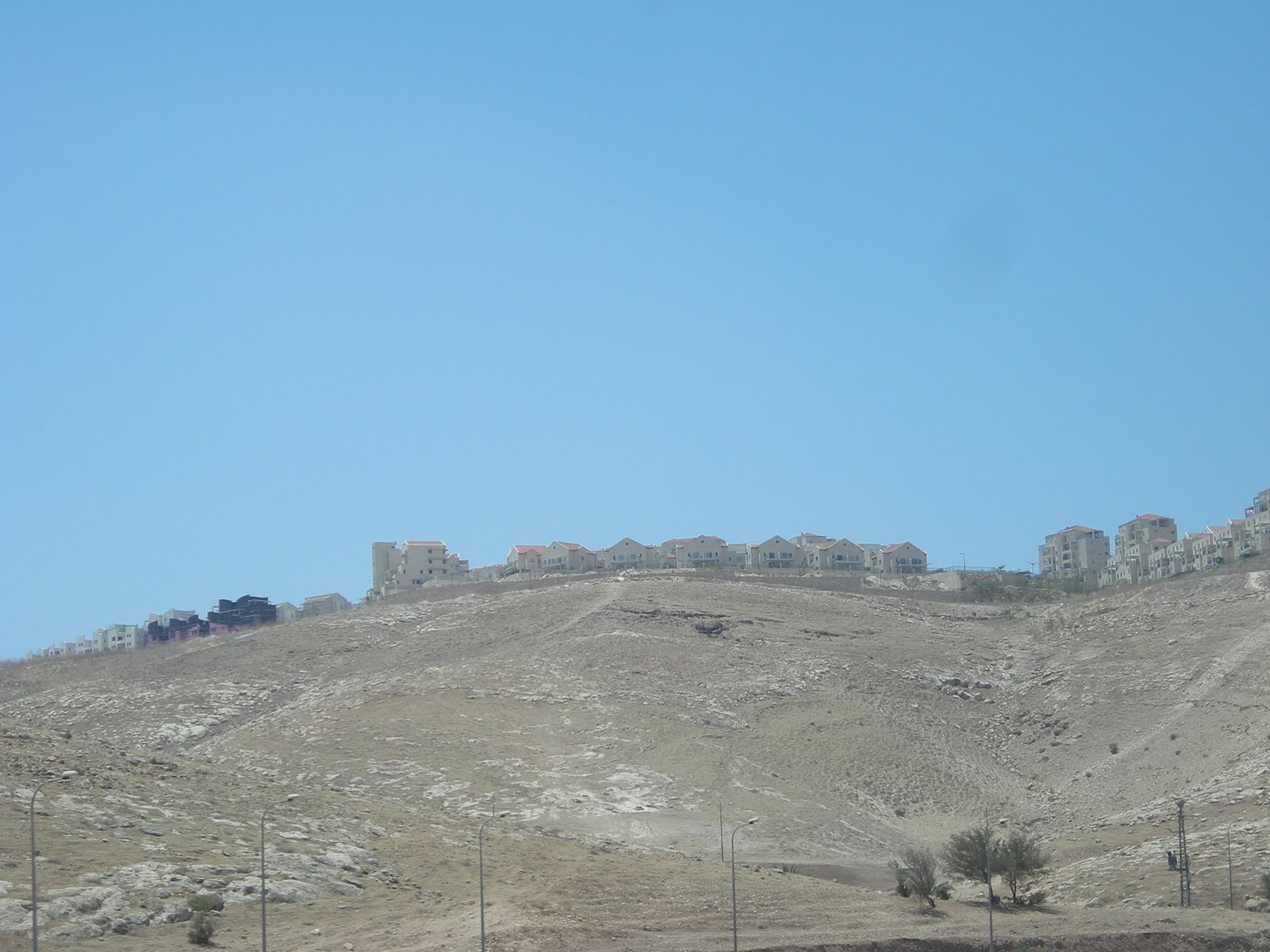
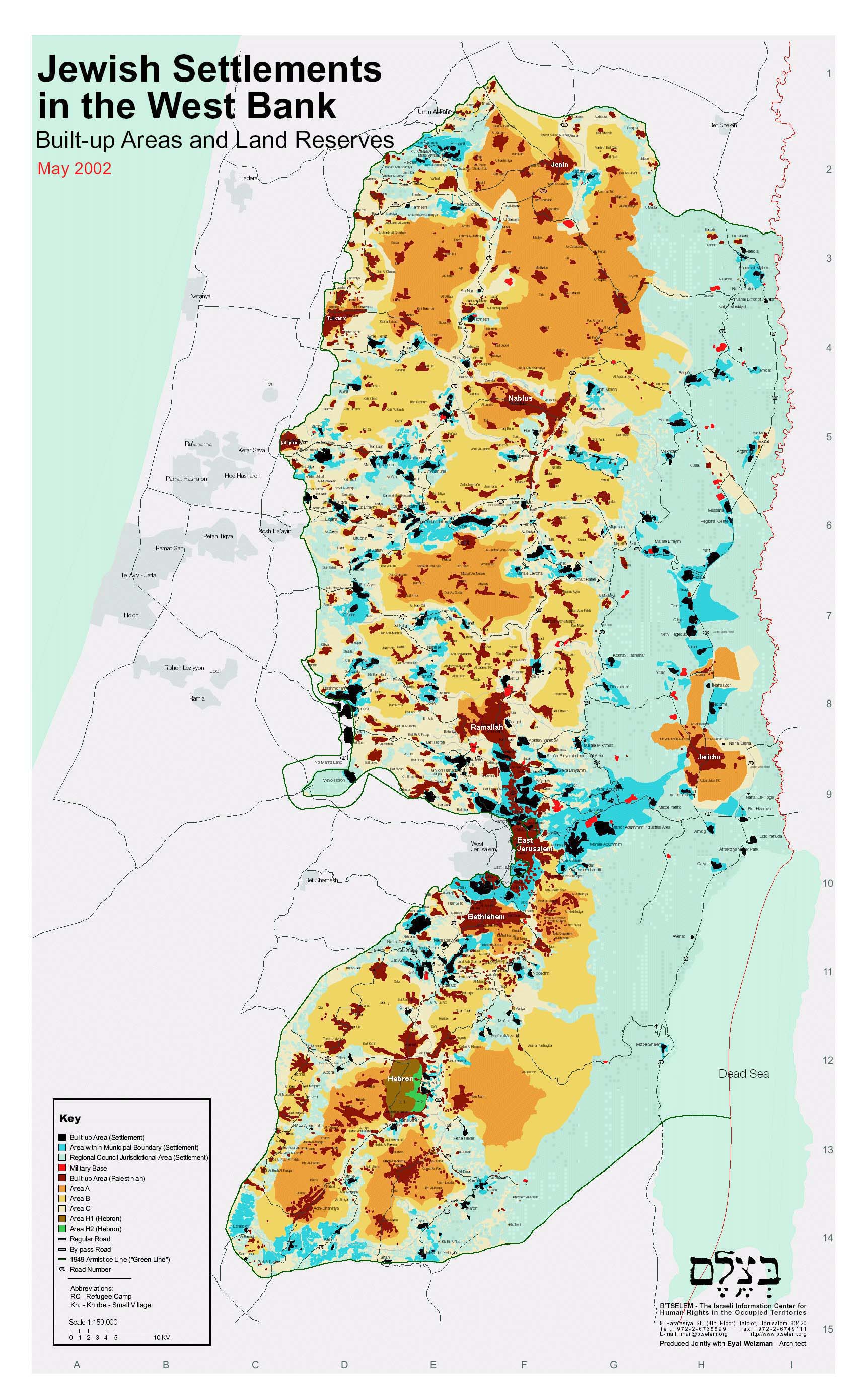
After we finally got through the Israeli checkpoint, we took a small bus through the West Bank to Jerusalem.  Along the way, we saw a few Israeli settlements that have been illegally constructed in Palestinian territory.  As you can see from the pictures, the settlements are all situated atop hills and surrounded by walls.  They are accessed by newly-paved highways that cut across Palestinian land, that can usually only be used by Israeli citizens.  The reason that I say these settlements are illegal is because they violate the Geneva Convention's prohibition on settling occupied territory (such as the West Bank).  Despite being illegal, Israel has allowed nearly 500,000 settlers to move into the West Bank.  At the same time, the Israeli government has been building a wall that zig-zags throughout the Occupied Territory.  The result is that about 44% of the West Bank has been effectively annexed by the state of Israel.  Sadly, the process is ongoing. When we visited Bethlehem (I'll talk about this in another post), we were able to see the construction crews building more houses in yet another illegal settlement.

Here are a couple of quick pictures that I took while riding through the West Bank:


If you are interested in learning more about this issue, I'd love to talk about it in person when I get back.  You can also go to http://www.btselem.org/ or http://www.ips-dc.org/mideast.  The first link is to the website of B'Tselem, an Israeli organization that is one of the most widely respected groups that compile statistics about the Israeli occupation.  The second link is to the page of one of my favorite commentators on US policy towards the Middle East, Phyllis Bennis.  Also, here is a link to a map of the Israeli settlements in the West Bank: http://www.btselem.org/download/settlements_map_eng.jpg (you can enlarge it to see it better).

Ok, so now that I wrote a lot more than I was planning on writing, I'll stop for now.  I'll post more as the week goes on, so hopefully by the end of this week I'll have covered the whole trip.  Stay tuned!


Saturday, July 23, 2011

Mensaf

It's been a while since my last post because I've been in Jerusalem since wednesday and I'm just now able to start posting about everything that has happened this week.  I'll start by talking about Monday, before my trip to Jerusalem, and then my next couple of posts will be about my trip.  On Monday night, one of our conversations partners (Yussef) invited Jim and I over his house to eat Mensaf - the traditional Jordanian dish composed of rice, chicken, nuts, what I think was parsley, and topped with cooked yogurt.  The cooked yogurt sounded a little iffy at first but it was actually really delicious!  In fact, the whole meal was by far the best meal that I've had here in Jordan.

Yussef's village is about 45 minutes away from Irbid by bus.  At about 5:00 pm, Jim and I, together with our 3 language partners (Yussef, Majd, and Khaled), headed out to Yussef's village.  When we arrived, we were invited to take off our shoes and enter their sitting room.  As far as I know, most traditional houses in Jordan have a carpeted sitting room right at the front of their house where they receive their guests.  This is the "public space" within the home, and thus it was the only room (besides the bathroom) that we saw of the house.  When we walked into the sitting room, we saw that it was lined on three sides with small mattresses and pillows on which we could sit and recline.  There was also a tv, stereo, and a computer on the 4th wall.  We then met Yussef's father, brother, and cousin who generously welcomed us into their home.

We sat and talked for about 20 minutes until the Mensaf arrived.  It was all on one big plate which we all ate off of.  The cooked yogurt was in a separate pot, and Yussef periodically poured some of it over the plate to ensure that the correct proportion of rice to chicken to yogurt was maintained.  As I said before, the meal was absolutely delicious.  We quickly devoured most of the plate.  After the meal, we returned back to our seats and drank water, and then soda.  The custom after the meal is for the host to fill up a cup of water and give it to one guest at a time.  The guests are supposed to drink half of the water and then return the glass to the host, who in turn fills it again and gives it to the next person.  This is repeated until everyone has drank from the glass.  Jim and I, being the guests of honor, were the first and second people to be offered this cup, but we did not know the tradition. First, Jim held on to his cup (without drinking it because he was skeptical of the water quality).  Seeing this, Yussef left the room to get another cup, which he then filled and gave to me.  I had a feeling that we would all drink from the same cup, mostly based on Yussef's body language, so I proceeded to drink the whole glass and by the time I was about 2/3 done, Yussef got another cup.  He filled this cup and gave it to Majd, Khaled, and everyone else who all drank half and gave it back.  They then explained that this was the custom.  Feeling slightly embarrassed, we apologized, but they took no offense.  They were very gracious.  I made sure to get it right the second time around.

Following the after dinner drinks, Khaled, Majd, and Yussef said there evening prayers, allowing us to watch because we were curious.  Muslims are obligated to pray 5 times a day - before the sunrise, in the early afternoon, right before sunset, shortly after sunset, and then later at night.  If there are multiple Muslims together, often one will take the lead in reciting the verses from the Quran outloud as they go through their ceremonial motions.  Since it was Yussef's house, Yussef led the prayers.  (If they are alone, it's normal for Muslims to just pray by themselves.)

When the prayers were finished, we left Yussef's house and went to his cousin Ibrahim's farm.  At the farm, we sat on the roof of one of the buildings and talked for a long time.  There was a cool breeze blowing across the fields of lemon and pomegranate trees.  To our left, we could see Palestine because Yussef's village is right on the border.  As we sat and talked, we were joined by several of Yussef and Ibrahim's friends, including the imam from one of the local mosques.  We drank coffee and tea, and talked late into the night about many different topics.  Mostly, we discussed Christianity and Islam because all of us enjoy talking about these subjects.  Jim and I explained some differences between Islam and Christianity, the main one being that we believe Jesus was the Son of God, and simultaneously God himself.

This was a difficult concept for them to grasp for a number of reasons.  The first reason is that Muslims believe that Jesus was a prophet, not the Son of God/God himself.  They hold Jesus in very high regard, but don't believe in His divinity.  Secondly, once we threw the Holy Spirit into the mix, it was difficult them to understand how we only believed in 1 God when we were talking about Father, Son, and Holy Spirit.  We just had to admit that the doctrine of the Trinity was difficult even for us to wrap our heads around.  We could understand why they kept asking us if there were 3 Gods or 1, or if one of the members of the Trinity was in charge of the other 2.  By the end of the conversation, I think that they understood that we only believe in 1 God, even if there are 3 parts.

Then we asked them some questions about Islam and Arab culture.  When we talked about women in Islam, they made sure to emphasize that in the Quran, men and women are equal.  This, in fact, was a revolutionary movement in Arab culture at the time, which previously had treated women as below men.  Another (unrelated) thing that we took away from the conversation was that since feet are seen as dirty, it's impolite to cross your legs in a way that points the bottom of your foot at another person.  I actually knew this prior to coming to Jordan.  What I didn't know about was that if you are among friends, it's actually not a problem.  When you are friends, everybody knows that you mean no offense, so it is acceptable.  This, incidentally, was a great relief to me because I am particularly fond of sitting with one leg propped up on the other and had previously been at pains to break myself of this habit when I was sitting with them.

At about 2:30 am, we decided we were tired, and should go to bed, so we headed downstairs to sleep.  Unfortunately, I did not sleep well, and we had to wake up at 6:00 am to catch the bus back to Irbid so that we could get to class on time.  It was worth the tiredness though.  I thoroughly enjoyed that night!  I'm sure it will remain one of my fondest memories of Jordan.

Here are some pictures:

Mensaf!

Yussef, Majd, and I getting ready to chow down.  You can see the bowl of cooked yogurt to the left of the plate.

From left: Khaled, Majd, Me, Jim, Yussef

Ibrahim's farm

Sunday, July 17, 2011

Wadi Rum

After a busy week of classes, most of my group went on yet another weekend excursion, this time to a place called Wadi Rum.  Wadi Rum is a desert in the south of Jordan that extends into Saudi Arabia.  It is a place simultaneously desolate and beautiful.  A 4x4 tour took us though the desert, hemmed on all sides by immense cliffs jutting out of the earth in fascinating formations.  Even the sand in Wadi Rum is unique, as it ranges from beige, to orange, and even red.

In addition to it's natural beauty, Wadi Rum is a place that has been long romanticized by the actions of Lawrence of Arabia during World War I.  Lawrence of Arabia, a British army officer, aided the successful Arab Revolt against the Ottomans that took place during the war.  The Ottomans sided with the Germans and the Austro-Hungarian Empire against Britain, France, and Russia, so it was in Britain's interest to facilitate a revolt against the Ottomans.  From their base in Wadi Rum, Lawrence and the Arab forces conquered Aqaba (where I was last weekend), and advanced all the way up to Damascus (in modern day Syria).

Wadi Rum is about a 6 hour drive south of Irbid.  We left Irbid at about 7:30am on Friday morning and arrived in Wadi Rum close to 1:30pm.  When we got there, we piled into old rickety trucks and set off into the desert.  The tour took about 4 - 4 1/2 hours and ended at a camp site where we watched the sunset, ate a meal prepared by some local bedouins, and slept outside under the stars.  We actually didn't do that much sleeping though.  Most of us were so caught up in the beauty of the scenery that we stayed up until like 2:30am and were up by 6:30am.  Those 4 hours of sleep were far from relaxing.  As we were warned, the desert gets pretty cold at night - unfortunately I returned to the campsite too late to get a blanket, so it got pretty chilly!  In the morning we woke up, soaked up the sunrise, had some breakfast, and headed back to Irbid.  It was a fantastic trip!  I was completely in awe of the stark beauty of the Wadi, and I had a long time to sit and ponder many things under the stars.

Here are some pictures.  As pretty as some of them are, they simply (and sadly) do not do justice to the awesome expanses and monstrous mountains that they depict.

Heading into the desert...


"Lawrence's Spring."  This spring is allegedly the place where Lawrence of Arabia and the Arab forces got their water from.

Our sweet ride...nearly 30 years old and still kickin!

Some petroglyphs from either the Nabateans or the Thamuds


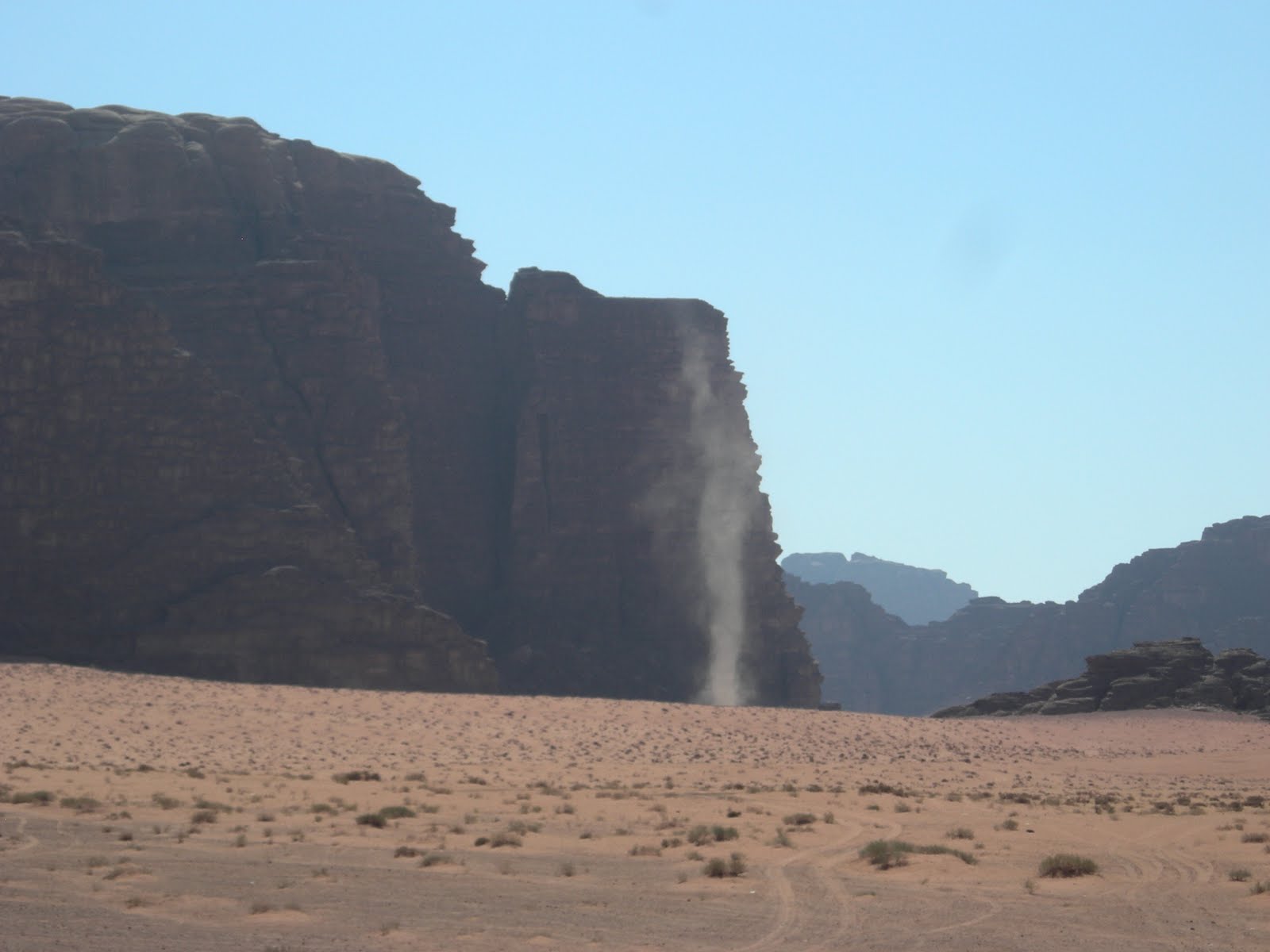
Sandstorm!!!  Well..maybe it wasn't that exciting, but it was kind of cool.

Most of the group (I took the picture from the top of a cliff, so I'm not in it)


One of the natural bridges

Our guide informs our group about what we are seeing


Some pictures during the sunset...


Our camp...we all slept outside in the middle of those tents.